FOLKSTEER
FOLKSTEER DEMOCRACY is democracy with NO RULING CLASS.
Folksteer democracy is a proposal for government by representative assemblies chosen by lot, with elected advocates but no elected rulers.Instead of concentrating power in presidents, politicians, parties, billionaires, and judges-for-life, Folksteer returns power to the people themselves.The people govern by lot.
The people speak by election.
The people rule together.
The folk steer government.
Folksteer democracy.
Essays and Thoughts:
“The appointment of magistrates by lot is thought to be democratic, and the election of them oligarchical.”
— Aristotle, Politics IV.9, 1294b7–10.For over two millennia, we have treated elections as the essence of democracy. Aristotle—the philosopher who gave us one of the earliest systematic studies of democracy—made a different distinction. He identified selection by lot as democracy’s defining institution and election as the defining institution of oligarchy. Folksteer revives that forgotten democratic tradition.

(c) 2026 Folksteer.com, Chris Hermansson
Born 4 July 2026 ~ the 250th
What is Folksteer?
Folksteer is democracy without a ruling class.In today’s system, we elect individual officeholders and then hand them enormous power. Presidents, governors, senators, judges, and party leaders become the center of political life. The rest of us are left to hope they use that power well.Folksteer changes the structure.In Folksteer democracy, the real governing authority belongs to large representative assemblies of the people, chosen by lot. These assemblies are not campaigns, not parties, not donor networks, and not political careers. They are the people themselves, gathered to deliberate, decide, and govern.
FOLKSTEER DEMOCRATIC ORGANIZATION
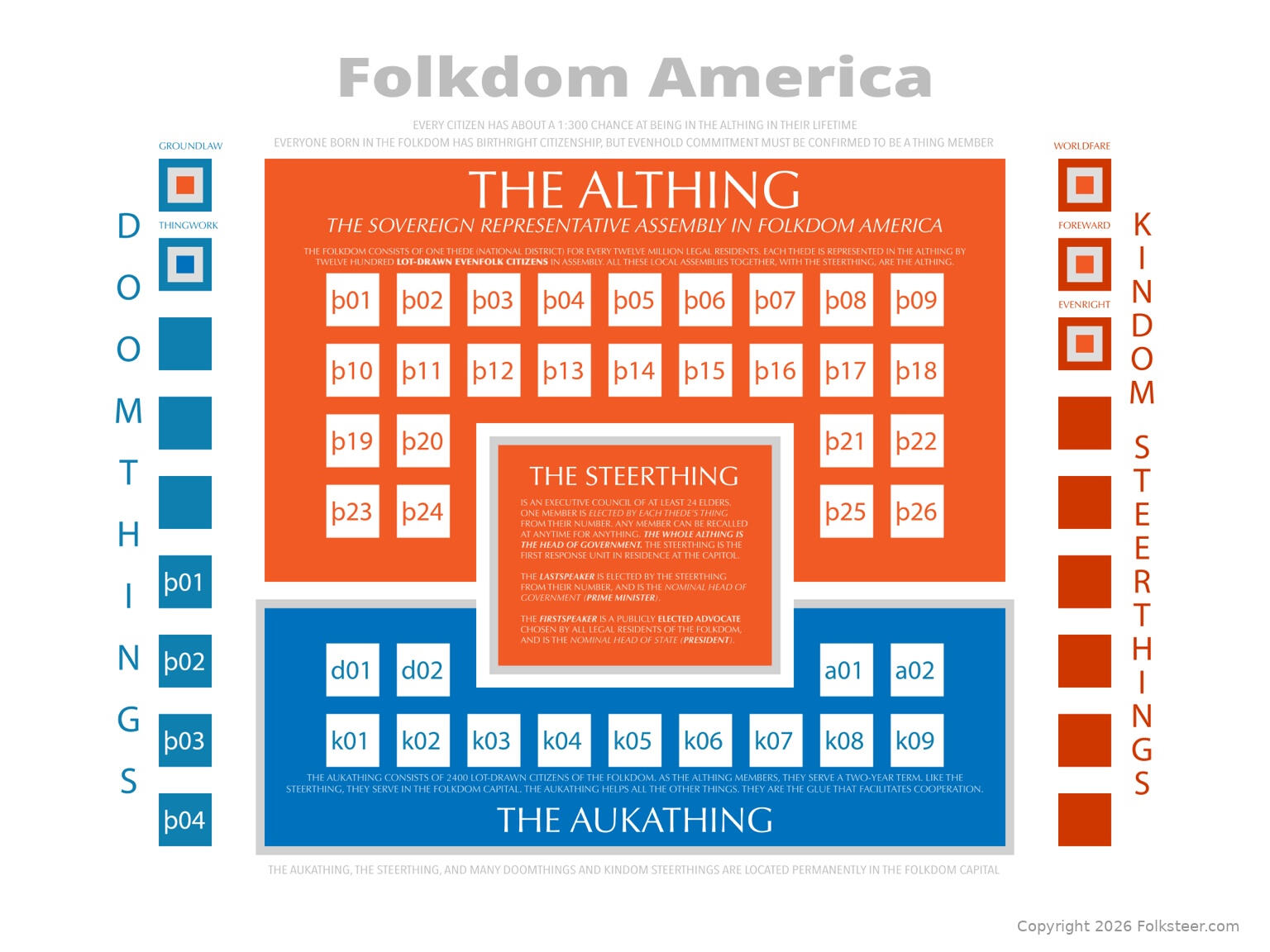
The chart above is showing the Folksteer democratic organization of the United States of America if it were to adopt the Folksteer Amendment to the Constitution. The name of the country would not necessarily have to change because states could persist in Folksteer government, but they would not be integral to the national government anymore. The states could still exists and function in some capacity, but they would mostly be cultural artifacts. Therefore, the name change (as shown Folkdom America) makes sense since the descriptive aspect of the name (mentioning States) is no longer relevant. The name for a Folksteer democratic republic is a Folkdom. It essentially means a Folksteer republic.
If you make the image larger you should be able to read most of the text. It’s actually very descriptive.
After noticing the name change of the country, you’ll notice that the Althing is the sovereign representative assembly in the country. The Althing necessitates the division of the country into regional districts of twelve (12) million people. These districts are called Thedes. Every Thede has a Thing, an assembly of 1200 lot-drawn citizens from that Thede. All of these Things together make the Althing. If applied today it would mean there would be 29 Things in the Althing and almost 35,000 lot-drawn members.
The Althing is the equivalent of the Ekklesia in ancient Athens’ democracy.In progress
Our Wordbook
These are the strange words that are used in Folksteer democracy and the Evenfolk Way. In some cases they are new words created from old English roots. Some are existing old English words that have resurrected meanings. The most notable of these is the word Thing, a democratic assembly. The first of the thing words is the Althing.Althing — (n., all + thing) A recognized English rendering of the Icelandic word Alþingi which is Iceland’s word for their National Assembly, the governing legislature. The word thing (þing) in old English (and in kindred tongues) originally meant a democratic governing assembly. It still means the same in Iceland today. The Althing is the thing (democratic assembly) of all the people.
The Althing (in the context of our democratic vision) is the primary governing institution (supreme authority) in the Folkdom, the republic. The Althing is made up of at least twelve hundred lot-drawn representatives from each Thede’s (regional district’s) democratic assembly, or Thing. The Althing is the sum of all the regional Things. It meets in virtual Moots with all the Things virtually together. The Althing meetings are coordinated and virtually take place with the in-person meeting of the Aukathing and the Steerthing, both in residence at the Capitol building.
The Althing is the modern equivalent of the Ekklesia in ancient Athenian democracy. If the Althing of Folkdom America were established today it would include 29 Thedes with 29 Things of 1200 lot-drawn citizens each for a total Althing membership of 34,800 folks representing all of us.Aukathing — (n., from old English ēacan (“to add, augment”) + thing) A standing, lot-drawn federal assembly ensuring continuity of governance. It facilitates the functioning and coordination of the Althing, Steerthing, and Doomthing; it functions as a civic keel keeping the ship of state steady and moving forward. It also oversees the functioning of all the administrative departments of the government. The Aukathing is the equivalent of the Boule (Council of 500) in ancient Athenian democracy.Firstspeaker — First Advocate, effective equivalent to a toothless President, a publicly elected position, symbolic head of state; they are the first speaker to address the Althing in the State of the Union address. They can speak as long as the Althing tolerates them.Folksteer — (n.; also v.) Democracy, understood as collective self-guidance by the people themselves, especially through lot-drawn and deliberative institutions. Folksteer emphasizes steering a common course rather than ruling by elected elites. It is a modern formation that comes from Old English: folk (folc, “people”) + steer (steoran, “to guide, direct, govern”). Folksteer is directly cognate with Swedish folkstyre and Danish folkestyre, both meaning “rule of the people” or democracy.Folkthing — A lot-drawn assembly that is called by referendum of the people. It can assemble, gather facts and opinions from all corners, deliberate on the issue at hand, and make recommendations for legislation that must be considered in the next regular session of the Althing. If the Althing agrees with the Folkthing, then the Folkthing’s recommendation will be treated as an Althing passing legislation, and will not require another Althing to pass the same legislation to establish the law.Steerthing — The executive council (the Presidency) of the Folkdom, a subordinate subset of the Althing with one lot-drawn Althinger from each Thing being elected by the assembly from their number to be a member of the Steerthing in residence at the Capitol building (along with the Aukathing).
The Steerthing is meant to be an avatar of the Althing. Any member of the Steerthing can be recalled to regular representative service at any time for any reason by majority vote of the Thing of their Thede, the Althing in general, or on a provisional basis by the Aukathing.Thing — (n., þing OE) originally meant a governing democratic assembly in Old English. Eventually it came to mean a topic talked about in a democratic assembly, and ultimately came to mean any conceivable subject or object; literally a stand-in, an avatar, shorthand.
The other kindred languages also had the old meaning for the word þing (or thing/ting). Some of them still retain this original meaning, even though they have mostly also changed their meanings like English. In Icelandic the word still means a democratic assembly as is reflected in the name of Iceland’s National Assembly, the Alþingi (Althingi, all + thing). Likewise with Denmark’s Folketing (folk + thing) and Norway’s Storting (great + thing).
Resurrecting the original meaning, a Thing in our political vision is the governing democratic assembly of a Thede, which is a twelve million resident national subdivision of the republic, the Folkdom. The Thing is composed of twelve hundred lot-drawn representatives from all the resident citizens of the Thede. The Thing members are all members of the one Althing, which is composed of all the Things.
Folksteer vs Officeholder democracy
Officeholder democracy is our term for the current political system in the United States. Though the US is hardly alone in subjecting their people to officeholder imperialism.Benefits of Folksteer democracy over Officeholder democracy:1. No more “lesser of two evils” traumaIn Officeholder democracy, citizens are regularly forced to choose between powerful individuals they may distrust, dislike, or morally reject. That is not a small inconvenience. It means the ordinary citizen has to internalize complicity: I hate this system, I hate these choices, but I still have to vote for one of them because the other is worse.That becomes spiritually corrosive. You live months or years in advance knowing that your political agency will be reduced to a grim defensive act. Pew found in 2024 that about a quarter of Americans had unfavorable views of both Biden and Trump, which captures exactly this “double rejection” problem. The American Psychological Association’s 2024 Stress in America report also identified the future of the nation, the economy, and the presidential election as top stressors.In Folksteer democracy, you would still vote. But you would not vote to hand sovereign power to one person. You would vote for advocates, visions, proposals, public voices, maybe Firstspeakers — but not rulers.2. No one person stands at the center of powerThis may be the single biggest structural benefit.Officeholder democracy concentrates public emotion around presidents, governors, senators, judges, party leaders, billionaires, and media personalities. Folksteer democracy breaks that spell. Power is filtered through the Thing, the Althing, the Steerthing, the Aukathing, and the Doomthing. No single personality becomes the vessel of national destiny.That means no savior politics. No strongman fantasy. No “only I can fix it.” No cult of the executive.3. The people become the institutionOfficeholder democracy says, “The people rule because they occasionally choose officeholders.”Folksteer democracy says, “The people rule because the people themselves are continuously present in government.”That is a massive difference. The public is no longer outside the building yelling at the powerful. The public is the building.4. Representation becomes real instead of theatricalElected officials are not a representative sample of the people. They are usually more ambitious, more connected, more polished, richer, more partisan, more legally protected, and more capable of surviving the campaign process than ordinary citizens.A lot-drawn Folkthing would include nurses, truck drivers, architects, teachers, retirees, warehouse workers, students, small business owners, caregivers, disabled people, renters, homeowners, veterans, immigrants, rural people, urban people, religious people, secular people — the actual human fabric of the country.Sortition’s democratic strength is that it is built on randomness, representation, and equality, and modern citizens’ assemblies are now one of the major forms of this practice.5. It weakens elite captureOfficeholder democracy is capture-prone because power flows through a small number of bottlenecks: candidates, donors, parties, lobbyists, judges, campaign consultants, media networks, and bureaucratic appointees.Folksteer democracy multiplies the points of public authority. You cannot buy “the senator” if there is no senator. You cannot own the president if the president does not govern. You cannot capture the whole system by capturing a few personalities.6. It removes careerism from the center of lawmakingIn Officeholder democracy, lawmaking is a career path.In Folksteer democracy, governing is civic service. Members are drawn, trained, supported, paid, protected, and then replaced. They do not spend their lives climbing toward power. They are temporarily entrusted with responsibility.That alone changes the moral atmosphere.7. It ends permanent campaign governmentOfficeholder democracy never stops campaigning. Even when officials are supposedly governing, they are fundraising, branding, polling, positioning, attacking, and preparing for the next election.Folksteer democracy would make campaigning secondary. Advocacy continues, but governance itself is not a campaign. The Althing can deliberate without needing to posture for donors or primary voters.8. It reduces the politics of humiliationOfficeholder democracy rewards domination: destroy the opponent, embarrass the rival, trigger the base, make the other side suffer.Folksteer democracy is more likely to reward explanation, persuasion, and ordinary problem-solving. People drawn by lot do not arrive as gladiators. They arrive as citizens who have to learn, deliberate, and decide.9. It lowers the emotional temperature of politicsWhen one president can change the courts, foreign policy, immigration enforcement, agency direction, war posture, civil rights enforcement, and the entire national mood, every election feels apocalyptic.Folksteer democracy lowers the stakes of any one person’s rise or fall. That does not make politics unimportant. It makes politics less traumatic.10. It makes authoritarianism structurally harderOfficeholder democracy always has a vulnerability: one person can win, inherit enormous power, corrupt institutions, intimidate opponents, and use the state as a personal instrument.Folksteer democracy denies that pathway. A would-be authoritarian needs a throne. Folksteer removes the throne.The concern about executive power is not imaginary. In Trump v. United States, the Supreme Court recognized broad presidential immunity for official acts, and recent coverage of the Court continues to describe major disputes over the scope of presidential authority.11. It separates public voice from governing powerThis is one of your strongest design insights.People can still elect speakers, advocates, parties, platforms, and public voices. But the elected advocate does not become the sovereign. The Firstspeaker may speak for a vision, but the Althing governs.That lets elections do what elections are good at: expression, persuasion, symbolic leadership, public agenda-setting.It stops elections from doing what they are bad at: choosing temporary monarchs.12. It makes corruption less efficientCorruption works best when power is concentrated. If a donor, lobbyist, corporation, foreign power, or ideological machine can influence a few key officeholders, it can distort policy for millions.In Folksteer democracy, influence has to pass through many rotating, representative bodies. That does not eliminate corruption, but it makes corruption harder, slower, more visible, and less efficient.13. It creates actual deliberationOfficeholder democracy mostly stages debate. Folksteer democracy creates deliberation.Debate is performance before an audience. Deliberation is citizens learning together, questioning experts, weighing tradeoffs, and changing their minds when warranted. The OECD has documented hundreds of representative deliberative processes and describes ways these can be structurally embedded in public decision-making rather than treated as one-off experiments.14. It gives ordinary people civic dignityOfficeholder democracy tells ordinary citizens: vote, donate, complain, volunteer, protest, then go home.Folksteer democracy tells them: you may be called to govern.That changes the dignity of citizenship. The people are not merely spectators, consumers, or mobs to be managed. They are possible lawmakers.15. It would produce less hatred toward governmentA person can hate a president. A person can hate a senator. A person can hate a Supreme Court majority. It is harder to hate a representative assembly of ordinary people who look like the country.Folksteer democracy does not require citizens to emotionally organize their lives around despised personalities.16. It breaks the celebrity-politician pipelineIn Officeholder democracy, fame becomes a substitute for wisdom. A person can enter power because they are entertaining, rich, outrageous, charismatic, famous, or media-effective.Folksteer democracy makes fame largely irrelevant to governing authority.17. It weakens party tribalismParties can still exist, but they become advocacy bodies rather than ruling machines.That is crucial. Parties can say, “Here is what we believe.” They should not be able to say, “Give us the state and we will rule you.”18. It makes government more like jury service than monarchyJury service is one of the few places where ordinary citizens are trusted with grave public responsibility. Folksteer democracy expands that principle.If citizens can judge guilt, liability, evidence, and life-altering legal questions, citizens can deliberate over public law — especially with training, expert testimony, transparency, and institutional support.19. It gives minorities better long-term representationOfficeholder democracy often gives minorities symbolic representation but not reliable governing presence.A properly designed lot system can ensure that the full population appears in government over time. Recent work on ongoing citizens’ assemblies emphasizes that rotating panels can improve representation across time, including for smaller groups that may not appear in every single panel.20. It turns politics away from domination and toward EvenholdOfficeholder democracy asks: who wins?Folksteer democracy asks: what do we owe each other?That is the Evenhold turn. It does not mean everyone becomes virtuous. It means the structure no longer rewards the worst forms of ambition as reliably as the present system does.21. It reduces despairIn Officeholder democracy, millions of people can feel trapped by a system they know is failing but cannot escape. The ballot becomes both sacred and humiliating: sacred because it is the only peaceful tool left, humiliating because the choices are so often unacceptable.Folksteer democracy offers a different emotional horizon: not “choose your ruler,” but “prepare the people to govern.”22. It makes “throw the bums out” unnecessaryThe problem is not merely that the wrong bums are in office. The problem is that the system keeps producing bums, rewarding bums, protecting bums, and making the rest of us choose between bums.Folksteer democracy does not need a permanent class of bums to throw out.23. It makes public office less addictivePower attracts people who want power. That is one of the great defects of Officeholder democracy.Folksteer democracy uses selection by lot, short service, rotation, accountability, and assembly control to reduce the intoxicating nature of office. There is less glory to chase.24. It creates a better kind of patriotismOfficeholder democracy often turns patriotism into loyalty to leaders, parties, flags, armies, myths, or enemies.Folksteer democracy can make patriotism mean loyalty to the people as a governing body. Not “my leader, right or wrong,” but “my fellow citizens, governing together.”25. It protects the public from personal grievance governmentThis is another huge one.In Officeholder democracy, one person’s ego, resentment, fear, revenge, ambition, or insecurity can become policy. A personal feud can become a national crisis.In Folksteer democracy, personal grievances still exist, but they are diluted through assemblies. They do not so easily become everyone else’s suffering.26. It reduces the need to forgive rulers who keep harming peopleOfficeholder democracy constantly asks citizens to endure the consequences of powerful people’s failures, then “move on.” Folksteer democracy would still require forgiveness among citizens, but less often in the horrific form of forgiving a ruler whose personal vice has damaged millions.27. It makes political loss less existentialIn Officeholder democracy, losing an election can mean losing the courts, the agencies, the executive branch, foreign policy, regulatory power, appointments, and basic protection.In Folksteer democracy, losing a vote means losing a decision — not surrendering the state to your enemies.28. It gives law more legitimacyPeople may disagree with a law. But if the law emerged from a representative, deliberative Althing rather than from party warfare, donor influence, executive pressure, and judicial ideology, it has a different kind of legitimacy.You may still say, “I think they were wrong.”But it is harder to say, “This was imposed by a ruling class.”29. It makes reform more possibleOfficeholder democracy often blocks reforms that most people want because those reforms threaten donors, parties, incumbents, or elite interests.Folksteer democracy gives reforms a better chance because ordinary citizens do not depend on campaign money, party leadership, or career advancement.30. It restores the meaning of democracyThe deepest benefit is the simplest:Democracy stops meaning “the people choose who rules them.”
Democracy starts meaning “the people rule.”That is the heart of Folksteer.In summary:Officeholder democracy makes us choose which powerful person to fear. Folksteer democracy removes the powerful person from the center and puts the people there instead.
The Evenfolk Way:
Evenhold, Folksteer and Folkdom
The trifecta
Letter to the Lazy Voter
Have you ever stayed home from an election because none of the candidates spoke for you? Because the choices felt false? Because the policies you actually believe in were not on offer? Or simply because life was too busy, too exhausting, or too far removed from the promises of campaign season?Folksteer democracy says that you still deserve representation.In officeholder democracy, representation depends on who runs, who gets funded, who survives the party system, who wins the election, and who actually keeps their promises afterward. Millions of people are left outside that process. Some vote for the lesser evil. Some vote for candidates who only partly represent them. Some do not vote at all. But all of them still live under the laws.Folksteer democracy begins from a different principle: the people themselves should be represented directly, faithfully, and in proportion to who they really are.That is why Folksteer democracy is built around large lot-drawn assemblies. A properly drawn assembly of ordinary people can mirror the public far more faithfully than a legislature made of career politicians, donors’ favorites, party loyalists, and media performers. Unless your beliefs are so rare that almost no one like you exists in the country, people broadly like you would have a real chance of being present in the governing body.In the American model, the Althing would include almost 35,000 lot-drawn representatives every two years. That is large enough to reflect the real moral, political, religious, regional, economic, and cultural diversity of the country. It would not just represent voters. It would represent the people.The standard Thing would include 1,200 representatives for a Thede of roughly 12 million people. The Things would meet locally and in person. Together, all the Things would form the Althing, meeting virtually as one national assembly. The Althing would be too large to function as a single physical chamber, but not too large to function as a distributed national body.Smaller lot-drawn bodies would also exist. Kindom Steerthings and the Steerthing of the Althing might be as small as 24 members, but they would not replace the people’s representation. Their role would be to steer, administer, and act within authority granted by the larger representative bodies. The center of democratic legitimacy would remain the large Things and the Althing as a whole.The whole goal is true representation.That is why Thedes should generally be equal in population. That is why Things should generally be equal in size. Equal people deserve equal representation.There may be special cases. Puerto Rico, as a possible First Thede, could make a strong case for geographical integrity and self-representation. Island nations, remote peoples, or distinct national communities such as Greenlanders, the Sámi, or the Kurds might require self-matching Thedes and Things if they joined a larger Folkdom. Remoteness, isolation, and national identity may sometimes justify special arrangements.But in the contiguous heartland of the Folkdom, the rule should be simple: equal Thedes, equal Things, equal representation.Folksteer democracy is not government by politicians who claim to speak for the people.It is government by the people, drawn from the people, reflecting the people, and making the decisions the people themselves would make if they had the time, the facts, the witnesses, the arguments, and the responsibility.
Fears of Mob Rule?
For those who fear that greater democracy may lead to mob rule—as many of the American Founders did—Folksteer democracy is deliberately structured to answer those fears.Its safeguards include:1. Decentralized deliberation. The Althing is composed of many separate Thing assemblies rather than one crowd gathered in one place. This makes a sudden wave of popular passion harder to ignite, coordinate, or sustain across the whole lawmaking body.2. Seconding by an entirely new Althing. No legislation becomes law through the judgment of a single group. Every measure must be Seconded by a later session of the Althing composed of completely different members. Under the ordinary rotation, this means that passage generally requires at least two years.3. A public interval for reflection. The time between the first deliberation and the Seconding allows the public to examine the proposal, challenge its assumptions, consider its likely consequences, and hear arguments from every side.4. Institutions for open public discussion. Structures such as FolkthingTV allow the wider public to follow deliberations, hear testimony, compare arguments, and take part in the continuing discussion between the first judgment and the Seconding.5. Higher thresholds for protected law. An ordinary majority may enact ordinary legislation, but legislation cannot be shielded from easy repeal without broader agreement. Supermajorities are required before one Althing may substantially bind those that follow.These are only some of Folksteer democracy’s protections against haste, passion, faction, manipulation, and temporary majorities. Folksteer gives the people governing power, but it does not ask them to govern in a single moment, as a single crowd, or without time for reflection.
Folksteer Democracy and Modern American DemocracyTwo Kinds of Political EqualityModern American democracy gives nearly every adult citizen an equal legal right to help choose who will govern.Folksteer democracy gives every eligible citizen an equal chance to govern.That is the deepest difference between them.Equalities and Other BlessingsFolksteer democracy Modern American democracy
Equal chance to become a representative. Every eligible citizen has the same chance of being drawn for service. Equal right to vote for a representative. Every eligible citizen may participate in choosing among the candidates presented.
Equal access to public power. Wealth, fame, connections, education, charisma, and political ambition do not improve your chance of being drawn. Equal freedom to seek public power. In principle, nearly any eligible citizen may campaign for office—though doing so successfully usually requires money, connections, party support, or public prominence.
Equal dignity within the assembly. Every Althinger enters as a full and even member, whether rich or poor, celebrated or unknown. Equal formal citizenship. The law does not formally assign greater voting rights to the rich, famous, educated, or well-connected.
Representation by resemblance. A sufficiently large assembly drawn from all the people naturally includes people of different regions, classes, occupations, races, beliefs, ages, and ways of life. Representation by selection. Voters can deliberately choose candidates whose principles, promises, experience, or character they prefer.
The people become the government. Ordinary citizens do not merely advise public officials; through their Things and the Althing, they exercise governing power. The people choose the government. Citizens periodically authorize particular officeholders to exercise governing power on their behalf.
No permanent ruling class is needed. Continuous rotation brings new people into public service while preventing political office from becoming a lifelong possession. Experienced officeholders can remain in service. Voters may retain officials who have acquired knowledge, skill, relationships, and institutional experience.
Representatives need not campaign. Althingers owe their place to the lot, not to donors, parties, advertisements, polling, or personal ambition. Candidates must publicly make their case. Campaigns can reveal their beliefs, abilities, temperament, history, and priorities before they receive power.
Representatives can deliberate without worrying about reelection. They may change their minds when evidence and discussion warrant it. Representatives can be judged at the next election. Voters may reward or punish them for their records in office.
Ordinary experience enters government directly. Nurses, laborers, caregivers, teachers, tradespeople, small-business owners, and others bring lived knowledge into public deliberation. Specialized political skill can be deliberately chosen. Voters can select people with legal, administrative, diplomatic, military, or legislative experience.
Money cannot buy seats in the Althing. There is no campaign to finance and no nomination to purchase or influence. Money cannot legally buy votes or offices. Elections remain subject to laws, disclosure requirements, contribution rules, and public scrutiny, however imperfect those safeguards may be.
Political parties may persuade but cannot distribute governing seats. Parties remain voices in public debate without becoming gatekeepers to the Althing. Parties organize public choices. They assemble coalitions, develop platforms, recruit candidates, coordinate legislation, and give voters recognizable alternatives.
Executive power is shared. The Steerthing is a council chosen from the Althing and removable by it, preventing one person from becoming the ruler of the nation. Executive responsibility is visible. The public knows who the president is and can identify the person expected to lead and answer for executive decisions.
Lawmaking requires patience. Seconding by a completely separate Althing gives the country time to examine, criticize, and reconsider a proposed law. Government can act within a single elected term. Legislation does not ordinarily require approval by two wholly different successions of representatives.
Continuity exists without political permanence. Rolling replacement preserves experienced members while continually admitting newly drawn citizens. Continuity comes through reelection and professional service. Long-serving officials and staff can retain institutional memory over many years.
Public advocates can still be elected. The people may choose Firstspeakers and other advocates to express a political direction without surrendering governing power to them. The people can elect leaders who possess power. A successful candidate may be authorized to turn a public program into government action.
It is difficult for a sudden movement to capture the whole government. Decentralized Things, staggered rotation, shared executive power, and Seconding frustrate authoritarian takeovers. A strong electoral movement can rapidly change national direction. When the public decisively supports a program, its elected leaders may claim a mandate to carry it out.Inequalities, Limitations, and Other CursesNeither system can abolish human folly, selfishness, prejudice, manipulation, or error. Each system merely distributes their risks differently.Folksteer democracy Modern American democracy
Your electoral vote ordinarily chooses a public voice, not a ruler. You may help elect a Firstspeaker to advocate for your convictions, but that person cannot command the government. Your vote may help place someone in power, but that power belongs to the officeholder—not to you. Once elected, the representative is not bound to follow your wishes.
You cannot choose the individual Althingers who represent the country. The lot may select people you dislike, distrust, or consider unqualified. You may choose among candidates, but not usually among the whole population. Donors, parties, primary voters, political networks, and ballot rules largely determine who reaches the final ballot.
Equal chance does not guarantee equal participation. Poor pay, insecure employment, disability, caregiving duties, or inaccessible procedures could still exclude people unless the system actively removes those barriers. Equal voting rights do not produce equally weighted influence. Wealth, free time, education, media access, geography, district boundaries, and institutional design all affect whose political voice carries furthest.
A representative cross-section is not automatically a wise assembly. Ordinary people can be misinformed, prejudiced, frightened, manipulated, or simply mistaken. Winning an election is not proof of wisdom. Campaigning tests fundraising, messaging, ambition, coalition-building, and public performance more directly than judgment or governing ability.
Althingers initially lack governing experience. Training, expert counsel, professional staff, and rolling continuity are indispensable. Experienced politicians may become a self-protecting political class. The skills required to remain in office can separate officeholders from ordinary life.
Responsibility is widely shared. When a large assembly makes a bad decision, the public may find it difficult to identify one person or faction to blame. Responsibility is supposedly concentrated but often evaded. Presidents blame Congress, chambers blame one another, parties blame the opposition, and officeholders blame agencies, courts, or procedure.
Deliberation takes time. Seconding guards against frenzy and error, but it can delay urgently needed laws. Speed depends on political alignment. Government may act quickly under unified power, yet remain paralyzed for years under divided institutions or procedural obstruction.
The system demands service from people who did not seek it. Some drawn citizens will be reluctant, uncomfortable, or eager to return home. The system disproportionately empowers those who seek power. The people most determined to hold office are not necessarily the people who should possess it.
Small groups may be absent from a particular draw. Random selection is highly representative overall, but it cannot guarantee every identity or viewpoint a seat in every assembly. Small groups can organize to win representation—but usually need concentrated numbers, money, favorable districts, party leverage, or exceptional political organization.
Experts advise without ruling. This protects popular sovereignty, but the assembly may reject sound professional advice. Experts and experienced officials may wield enormous influence. Their knowledge can improve policy, but their assumptions and institutional interests can also override ordinary people’s needs.
A persuasive demagogue may influence thousands of Althingers. Sortition removes the electoral road to dictatorship, but it cannot eliminate propaganda or mass manipulation. A persuasive demagogue can win an office already endowed with enormous power. Celebrity, grievance, media dominance, and party loyalty can become instruments of personal rule.
Corruption must target many changing citizens. That makes capture harder, but bribery, intimidation, secret coordination, and information manipulation remain possible. Corruption can concentrate on a relatively small number of durable decision-makers. Donors, lobbyists, corporations, parties, and wealthy networks know exactly whose favor they need.
There is no promise that the Althing will give the people what they presently want. Its members must deliberate and decide rather than act as instructed delegates. There is no promise that election winners will do what voters wanted. Campaign promises may be abandoned, compromised, obstructed, or subordinated to donors and party leadership.
Most citizens will never serve, despite having an equal chance. Equality of opportunity to govern cannot mean that everyone personally holds office. Most citizens will never hold meaningful power, and their chances were never equal. Nearly everyone may vote, but only an unusually financed, connected, ambitious, or prominent few become national officeholders.
Folksteer cannot guarantee good government. It can make government broadly representative, resistant to capture, and accountable to assemblies of ordinary people—but the people can still choose badly. Elections cannot guarantee representative government. They can provide choice, peaceful succession, public authorization, and removal—but they repeatedly elevate a narrow political class.The ChoiceModern American democracy says:Every citizen should have an equal vote in choosing the few who govern.Folksteer democracy says:Every citizen should have an equal chance to be one of the many who govern.The current system gives the people a recurring choice among prospective rulers.Folksteer gives the people the helm.Modern American democracy offers equal citizenship at the ballot box. Folksteer carries that equality into the government itself.
Folksteer Amendment
Text